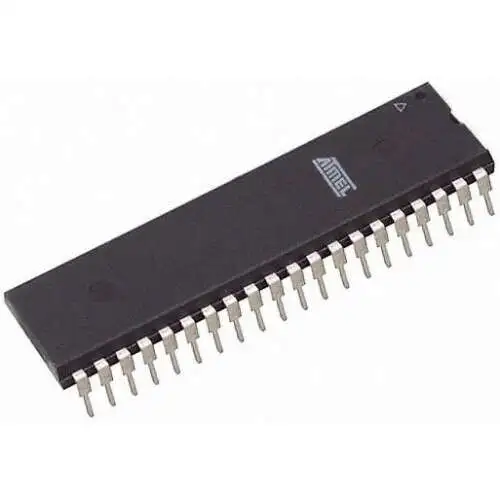
ATMega32A-U 8-Bit AVR Dip
EGP 247.99
See other suppliers →Description
ATMega32A-U 8-Bit AVR Dip is a high-quality electronic component designed for Arduino, prototyping, and educational electronics. ATMEGA32 Features ATMEGA32 – Simplified Features CPU 8-bit AVR Number of Pins 40 Operating Voltage (V) +2.7 to +5.5 V (+5.5V being absolute maximum) Number of I/O pins 32 Communication Interface JTAG Interface(24,25,26,27 PINS)[Can be used for programming this controller] Master/Slave SPI Serial Interface(5,6,7,8 PINS) [Can be used for programming this controller] Programmable Serial USART(14,15 PINS) [Can be used for programming this controller] Two-wire Serial Interface(22,23 PINS)[Can be used to connect peripheral devices like sensors and LCDs] ADC Module 8 channels , 10-bit resolution ADC Timer Module Two 8-bit counters, One 16-bit counter [Total three] Analog Comparators 1 DAC Module Nil PWM channels 4 External Oscillator 0-16MHz Program Memory Type Flash Program Memory (KB) 32Kbytes[10000 write/erase cycles] CPU Speed (MIPS) 16 MIPS RAM Bytes 2KBytes Data EEPROM 1024 Bytes Watchdog Timer Programmable Watchdog Timer with Separate On-chip Oscillator Power Save Modes Six Modes[Idle, ADC Noise Reduction, Power-save, Power-down, Standby and Extended Standby] Operating Temperature -55°C to +125°C(+125 being absolute maximum, -55 being absolute minimum) ATMEGA32 Pin Configuration Pin No. Pin name Description Alternate Function 1 PB0(XCK/T0) Pin 0 of PORTB T0( Timer0 External Counter Input) XCK ( USART External Clock I/O) 2 PB1(T1) Pin 1 of PORTB T1(Timer1 External Counter Input) 3 PB2(INT2/AIN0) Pin 2 of PORTB AIN0(Analog Comparator Positive I/P) INT2( External Interrupt 2 Input) 4 PB3(OC0/AIN1) Pin 3 of PORTB AIN1(Analog Comparator Negative I/P) OC0 (Timer0 Output Compare Match Output) 5 PB4(SS) Pin 4 of PORTB SS (SPI Slave Select Input). This pin is low when controller acts as slave. [Serial Peripheral Interface (SPI) for programming] 6 PB5(MOSI) Pin 5 of PORTB MOSI (Master Output Slave Input). When controller acts as slave, the data is received by this pin. [Serial Peripheral Interface (SPI) for programming] 7 PB6(MISO) Pin 6 of PORTB MISO (Master Input Slave Output). When controller acts as slave, the data is sent to master by this controller through this pin. [Serial Peripheral Interface (SPI) for programming] 8 PB7(SCK) Pin 7 of PORTB SCK (SPI Bus Serial Clock). This is the clock shared between this controller and other system for accurate data transfer. [Serial Peripheral Interface (SPI) for programming] 9 RESET Reset Pin, Active Low Reset Pulled HIGH to RESET controller. 10 Vcc Vcc = +5V 11 GND GROUND 12 XTAL2 Connected to Crystal Oscillator 13 XTAL1 Connected to Crystal Oscillator 14 PD0(RXD) Pin 0 of PORTD RXD (USART Input Pin) USART Serial Communication Interface [Can be used for programming] 15 PD1(TXD) Pin 1 of PORTD TXD (USART Output Pin) USART Serial Communication Interface [Can be used for programming] 16 PD2(INT0) Pin 2 of PORTD External Interrupt INT0 17 PD3(INT1) Pin 3 of PORTD External Interrupt INT1 18 PD4(OC1B) Pin 4 of PORTD PWM Channel Outputs 19 PD5(OC1A) Pin 5 of PORTD 20 PD6(ICP) Pin 6 of PORTD Timer/Counter1 Input Capture Pin 21 PD7 (OC2) Pin 7 of PORTD Timer/Counter2 Output Compare Match Output 22 PC0 (SCL) Pin 0 of PORTC TWI Interface 23 PC1 (SDA) Pin 1 of PORTC 24 PC2 (TCK) Pin 2 of PORTC JTAG Interface 25 PC3 (TMS) Pin 3 of PORTC 26 PC4 (TDO) Pin 4 of PORTC 27 PC5 (TDI) Pin 5 of PORTC 28 PC6 (TOSC1) Pin 6 of PORTC Timer Oscillator Pin 1 29 PC7 (TOSC2) Pin 7 of PORTC Timer Oscillator Pin 2 30 AVcc Vcc for Internal ADC Converter 31 GND GROUND 32 AREF Analog Reference Pin for ADC 33 PA7 (ADC7) Pin 7 of PORTA ADC (Analog to Digital Converter) Channel 7 34 PA6 (ADC6) Pin 6 of PORTA ADC (Analog to Digital Converter) Channel 6 35 PA5 (ADC5) Pin 5 of PORTA ADC (Analog to Digital Converter) Channel 5 36 PA4 (ADC4) Pin 4 of PORTA ADC (Analog to Digital Converter) Channel 4 37 PA3 (ADC3) Pin 3 of PORTA ADC (Analog to Digital Converter) Channel 3 38 PA2 (ADC2) Pin 2 of PORTA ADC (Analog to Digital Converter) Channel 2 39 PA1 (ADC1) Pin 1 of PORTA ADC (Analog to Digital Converter) Channel 1 40 PA0 (ADC0) Pin 0 of PORTA ADC (Analog to Digital Converter) Channel 0 Where to Use ATMEGA32 ATMEGA32 is easy to program AVR controller. With appreciable program memory it can satisfy most EMBEDDED SYSTEMS. With various sleep modes it can work on MOBILE EMBEDDED SYSTEMS. Along with 32 programmable Input/Output pins, it can interface many peripherals easily. With Watchdog timer to reset under error it can be used on systems with no human interference. With so many features with each appreciating other we can implement ATMEGA32 in many control systems. How to Use ATMEGA32 Using ATMEGA32 is similar to any other microcontroller. Similar to them it is not Plug and Play digital ICs. For working of ATMEGA32, first we need to save the appropriate program file in the ATMEGA32 FLASH memory. After dumping this program code, the controller executes this code to create the response. Entire process of using an ATMEGA32 goes like this: List the functions to be executed by ATMEGA32 write the functions in IDE programs using relative language (Usually Atmel Studio 6.2 for Windows7, Atmel Studio 7 for Windows10 (For these IDE the functions should be written in ‘C’ language) After writing the desired program compile for error elimination using IDE. Opt the IDE application to generate HEX file for the written program. Choose the programming device (usually SPI programmer made for AVR controllers) which establishes communication between PC and ATMEGA32 Run the HEX file dumping software which is related to the chosen programming device. Choose the appropriate program HEX file in the SPI or other programmer software. Burn the HEX file of program in ATMEGA32 flash memory using this program. Disconnect the programmer, connect the appropriate peripherals for the controller and power the sytem. Applications There are thousands of applications for ATMEGA32. Temperature control systems Analog signal measuring and manipulations. Embedded systems like coffee machine, vending machine. Motor control systems. Digital signal processing. Peripheral Interface system. Datasheet Microchip Tech ATMEGA32A-PU It’s perfect for DIY makers, students, and anyone building custom electronic circuits or STEM kits.
From the supplier's page.
makhzan doesn't sell — every offer opens the supplier's own site.