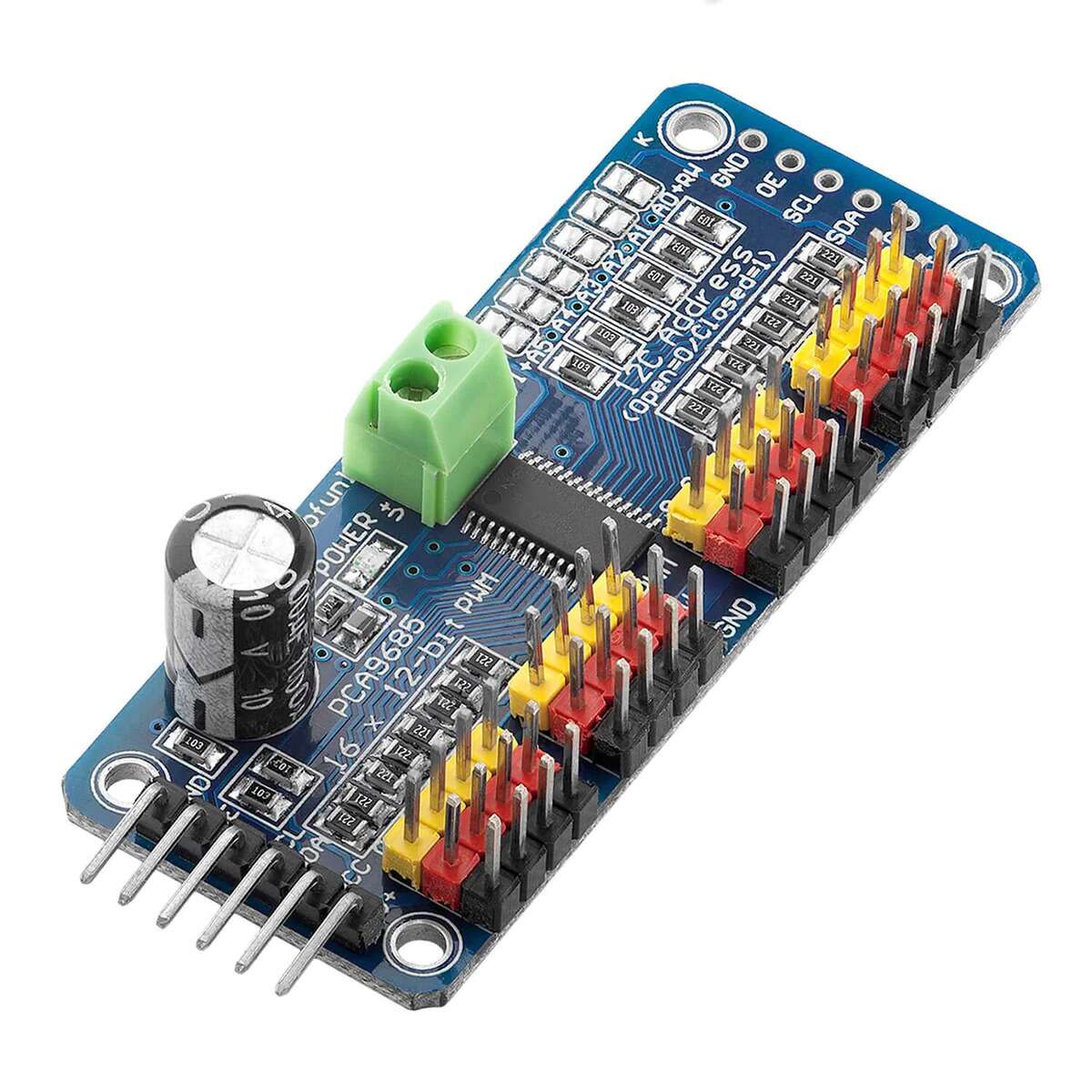
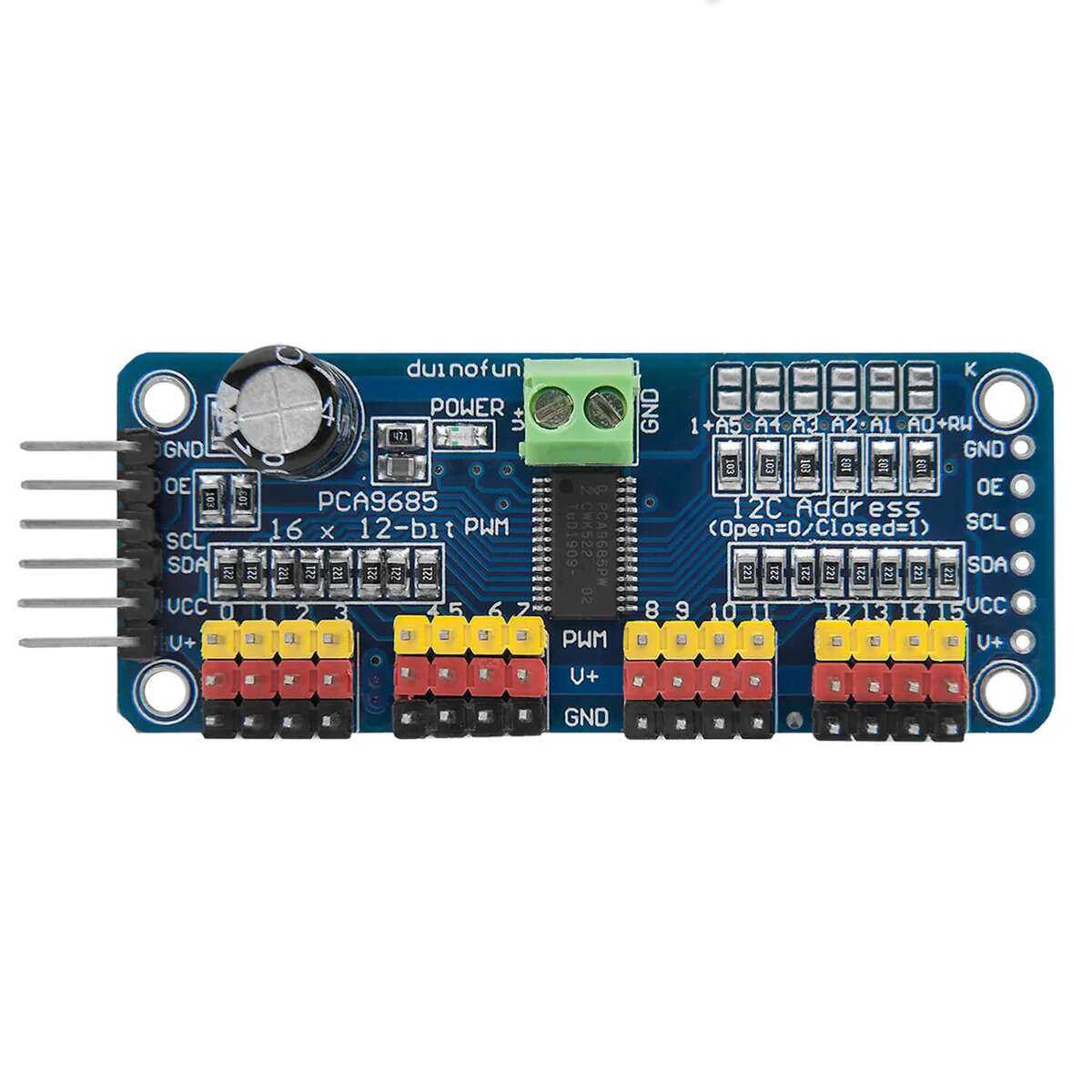
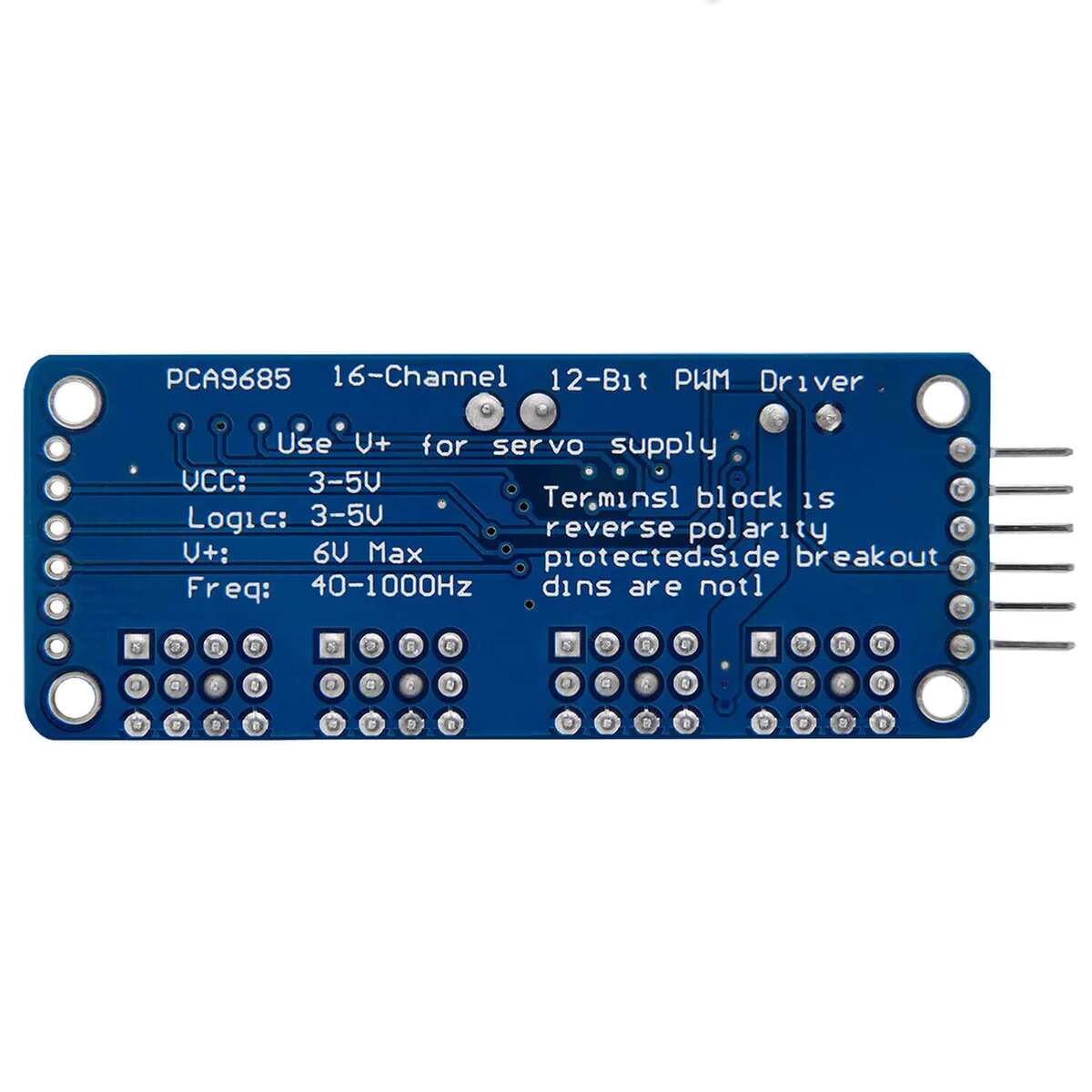


PCA9685 Servo Motor 16 Channel Driver
Part number PCA9685
Offers
lowest price firstEach offer shows the shop's own title.
- PCA9685 Servo Motor 16 Channel Driver·checked 19 days agoEGP 190
- PCA9685 PWM Servo Motor Driver Module,16-Channel 12-bit·checked 20 days agoEGP 205
- PCA9685 16-Channel 12-Bit PWM Servo Driver Module·checked 26 days agoEGP 209
- PCA9685 16-Channel 12-bit PWM Servo Motor Driver I2C Module for Arduino·checked 14 days agoEGP 210
- 16-Channel 12-bit PWM/Servo Driver I2C interface PCA9685 for Arduino Raspberry Pi·Price may be out of date (74 days)EGP 210
Details
FromFrom Makers Electronics's description
PCA9685 Servo Motor 16 Channel Driver The PCA9685 is a 16-channel, 12-bit PWM servo motor driver controlled via the I²C-bus. Originally designed as an LED controller, its precise pulse width modulation (PWM) capabilities make it an excellent choice for driving servo motors in applications such as robotics, automation, animatronics, and more. With individual control over each of its 16 channels and a resolution of 4096 steps, this driver enables accurate positioning of multiple servo motors simultaneously. Operating on a supply voltage range of 2.3 V to 5.5 V and featuring a user-friendly I²C interface, the PCA9685 integrates seamlessly with popular microcontrollers like Arduino and Raspberry Pi, making it a versatile addition to any electronics project. PLEASE NOTE: The PWM output pins on this module are capable of sinking a maximum of 25mA or sourcing a maximum of 10mA. Do not attempt to drive high-current devices such as motors, bulbs, etc, directly from these pins as you will risk damaging the module. For servos, power is provided externally via the terminal header and only a small amount of current is drawn by the servo from each PWM pin. Features: 16 Independent PWM Channels: Control up to 16 servo motors with individual precision. 12-Bit Resolution: Offers 4096 steps per channel for high-precision servo positioning. Programmable PWM Frequency: Adjustable from 24 Hz to 1526 Hz, typically set to 50 Hz for standard servo motors. Individual Timing Control: Programmable on and off times for each channel to reduce power surges and mechanical stress. I²C-Bus Interface: Supports Fast-mode Plus (Fm+) with speeds up to 1 MHz for efficient communication. Scalable Design: 6 hardware address pins allow connection of up to 62 devices on the same I²C-bus. Group Control: Software-programmable I²C addresses enable simultaneous control of multiple devices or groups. Output Enable Pin: Active LOW Output Enable (OE) pin to easily enable or disable all outputs. Internal Oscillator: 25 MHz typical internal oscillator; optional external clock input up to 50 MHz. Power Efficiency: Low standby current and support for hot insertion. Wide Operating Range: Functions reliably from -40°C to +85°C. Specifications: Specification Details Supply Voltage: 3 V to 6 V I²C-Bus Frequency: Up to 1 MHz (Fast-mode Plus) PWM Resolution: 12 bits (4096 steps) PWM Frequency Range: 24 Hz to 1526 Hz Output Drive Capability: 25 mA sink, 10 mA source at 5 V Package Options: TSSOP28, HVQFN28 Operating Temperature: -40°C to +85°C Output Configuration: Totem pole or open-drain (software selectable, default totem pole) Internal Oscillator: 25 MHz External Clock Input: Up to 50 MHz (max) Number of Channels: 16 ESD Protection: Exceeds 2000 V HBM, 200 V MM, 1000 V CDM Latch-up Testing: Exceeds 100 mA per JESD78 Pinout: Pinout: Pin Description GND This is the power and signal ground pin, which must be connected. VCC This is the logic power pin. Connect this to the logic level you want to use for the PCA9685 output (should be 3–5V max!). It’s also used for the 10k pull‑ups on SCL/SDA, so unless you have your own pull‑ups, have it match the microcontroller’s logic level too. V+ This is an optional power pin that will supply distributed power to the servos. If you are not using servos you can leave it disconnected. It is not used at all by the chip. You can also inject power from the 2‑pin terminal block at the top of the board. You should provide 5–6 VDC if you are using servos. If necessary, you can go higher to 12 VDC, but if you mess up and connect VCC to V+, you could damage your board. SCL I2C clock pin. Connect to your microcontroller I2C clock line. Can use 3V or 5V logic, and has a weak pull‑up to VCC. SDA I2C data pin. Connect to your microcontroller I2C data line. Can use 3V or 5V logic, and has a weak pull‑up to VCC. OE Output enable. Can be used to quickly disable all outputs. When this pin is low, all pins are enabled. When the pin is high, the outputs are disabled. Pulled low by default, so it’s an optional pin. Applications: Robotics and Automation: Ideal for controlling multiple joints or actuators in robotic systems. Animatronics and Puppetry: Enables lifelike movements in animated figures. Remote-Controlled Vehicles and Drones: Perfect for managing steering, throttle, and other servo-driven components. Camera Gimbals and Stabilization Systems: Provides precise multi-axis control for camera stabilization. Multi-Servo Projects: Suited for any application requiring accurate control of multiple servo motors. Package Contents: 1x PCA9685 Servo Motor 16 Channel Driver. Datasheet
Read moreShow less
From Most Electronic's description
The PCA9685 16-Channel Servo Driver Module generates 16 independent PWM signals through an I2C interface. Therefore, it provides an efficient solution for robots, animatronics, RC projects, and automation systems. The onboard PCA9685 chip provides 12-bit PWM resolution with 4096 steps per channel. In addition, it generates the PWM signals internally. This feature reduces the processing load on the main microcontroller. Key Features Controls up to 16 servos or PWM channels Provides 12-bit resolution with 4096 steps Communicates through the I2C interface Requires only SDA and SCL control lines Generates PWM signals independently Offers a programmable PWM frequency Includes six configurable address jumpers Supports multiple modules on one I2C bus Provides separate connections for logic and servo power Works with Arduino, ESP32, STM32, and Raspberry Pi Technical Specifications Main IC: PCA9685 Number of Channels: 16 PWM Resolution: 12-Bit, 4096 Steps Communication Interface: I2C Default I2C Address: 0x40 Logic Supply Voltage: 2.3–5.5V DC Input Logic Tolerance: Up to 5.5V Typical PWM Frequency Range: Approximately 24–1526Hz Common Servo Frequency: 50–60Hz Address Selection: A0 to A5 Solder Jumpers Maximum Modules: Up to 62 on one I2C bus Maximum Theoretical Channels: 992 Servo Power: External supply according to servo requirements Operating Temperature of IC: -40°C to +85°C Connections VCC: Logic supply for the PCA9685 chip GND: Common ground connection SDA: I2C data line SCL: I2C clock line OE: Active-low output enable V+: External power input for the servos PWM0–PWM15: Servo or PWM signal outputs Each servo header normally provides: GND: Servo ground V+: External servo power PWM: Servo control signal Powering the Servos Use the VCC pin only to power the module’s logic circuit. Meanwhile, connect a separate regulated supply to the V+ terminal for the servos. For example, many standard servos require a 5–6V supply. However, always check the voltage and current rating of your specific servo. Connect the controller ground and servo-power ground together. Otherwise, the PWM signals may not work correctly. Expanding the Number of Channels The six address jumpers allow up to 62 PCA9685 devices on one I2C bus. As a result, one controller can theoretically address up to 992 PWM channels. However, large systems require careful power distribution. Cable resistance, supply current, I2C capacitance, and electrical noise may limit the practical number of connected boards. Applications The PCA9685 module suits projects such as: Multi-servo robotic arms Hexapod and quadruped robots Animatronic systems RC vehicles and models Pan-and-tilt mechanisms Automated mechanical systems Low-current LED dimming Arduino and Raspberry Pi projects STEM and educational experiments Important Notes Do not power several servos directly from the Arduino 5V pin. Use a separate supply with enough current for the connected servos. Connect all grounds together before operating the system. Large servos can draw high startup and stall currents. Add sufficient power-supply capacity for simultaneous servo movement. Check the polarity before connecting power to the V+ terminal. The PCA9685 controls servo signals but does not provide the servo operating current. Use external drivers for high-power LEDs and other high-current loads. All channels share the same PWM frequency, but each channel has an independent duty cycle. Package Includes 1× PCA9685 16-Channel 12-Bit PWM Servo Driver Module
Read moreShow less
From Micro Ohm's description
If you want to make a robot which has lots of moving parts or if you want to control too many LEDs with PWM outputs, then the limited PWM outputs of your microcontroller would be a big problem for you. To overcome this problem, the only thing you should do is to get a 16-Channel 12-Bit PWM/Servo Driver . You can control 16 free-running PWM outputs with 16-Channel 12-Bit PWM/ Servo Driver using only 2 pins . You can even chain up 62 breakouts to control up to 992 PWM outputs . It’s an I2C -controlled PWM driver with a built-in clock. That means you do not need to continuously send it to signal to tie up your microcontroller, it is completely free running! It is 5V compliant, which means you can control it from a 3.3V microcontroller and still safely drive up to 6V outputs. This is good when you want to control white or blue LEDs with 3.4 forward voltages. 6 address select pins so you can wire up to 62 of these on a single I2C bus, a total of 992 outputs. Features : Adjustable frequency PWM up to about 1.6 KHz 12-bit resolution for each output – for servos, that means about 4us resolution at a 60Hz update rate Configurable push-pull or an open-drain output The output enable pin to quickly disable all the outputs Terminal block for power input Reverse polarity protection on the terminal block input Green power-good LED 3 pin connectors in groups of 4 so you can plug in 16 servos at once Chainable design A spot to place a big capacitor on the V line 220-ohm series resistors on all the output lines to protect them, and to make driving LEDs trivial. This board/chip uses I2C 7-bit address between 0x60-0x80, selectable with jumpers. Package Includes : 1 x 16-Channel 12-bit PWM/Servo Driver PCA9685 Datasheet: DOWNLOAD Driver IC PCA9685 Length (mm) 62 Width (mm) 25 Height (mm) 15 Weight (gm) 10 Shipment Weight 0.015 kg Shipment Dimensions 8 × 4 × 3 cm
Read moreShow less
From Ampere Electronics's description
PCA9685 PWM Servo Motor Driver Module,16-Channel 12-bit The PCA9685 servo driver module is used applications where large number of servo motors are used such as robot arm, hexapod and robots. It increases the number pf PWM output of your microcontroller. Using only two pins, you can control 16 free-running PWM outputs. That means that, you do not need to continuously send signal from your microcontroller, it’s completely free running, Adjustable frequency PWM up to about 1.6KHz 12-bit resolution for each output – for servos, that means about 4us resolution at a 60Hz update rate Configurable push-pull or an open-drain output The output enable pin to quickly disable all the outputs Terminal block for power input Reverse polarity protection on the terminal block input Green power-good LED 3 pin connectors in groups of 4 so you can plug in 16 servos at once Chainable design A spot to place a big capacitor on the V line 220-ohm series resistors on all the output lines to protect them, and to make driving LEDs trivial. This board/chip uses I2C 7-bit address between 0x60-0x80, selectable with jumpers. Package includes: 1x PCA9685 PWM Servo Motor Driver Module Datasheet: PCA9685 Datasheet Category: Motor Drivers Servo Motors
Read moreShow less
Similar products
 JF-0530B Linear Solenoid Push Type 12V 300mA 10mm 5NEGP 1901 shopchecked 24 days ago
 DIY KIT Mini Wind Power Turbine Generator System with DC MotorEGP 1901 shopchecked 17 days ago
 RP390-ST-24100 DC Motor 12V to 24V 9426RPMEGP 1901 shopchecked 15 days ago
 Push Type Linear Solenoid JF-0530B 24V 300mA 10mm 5NEGP 1901 shopchecked 24 days ago
 Robot Wheel 65mm + Metal Coupler 4mmEGP 194.691 shopchecked 11 days ago
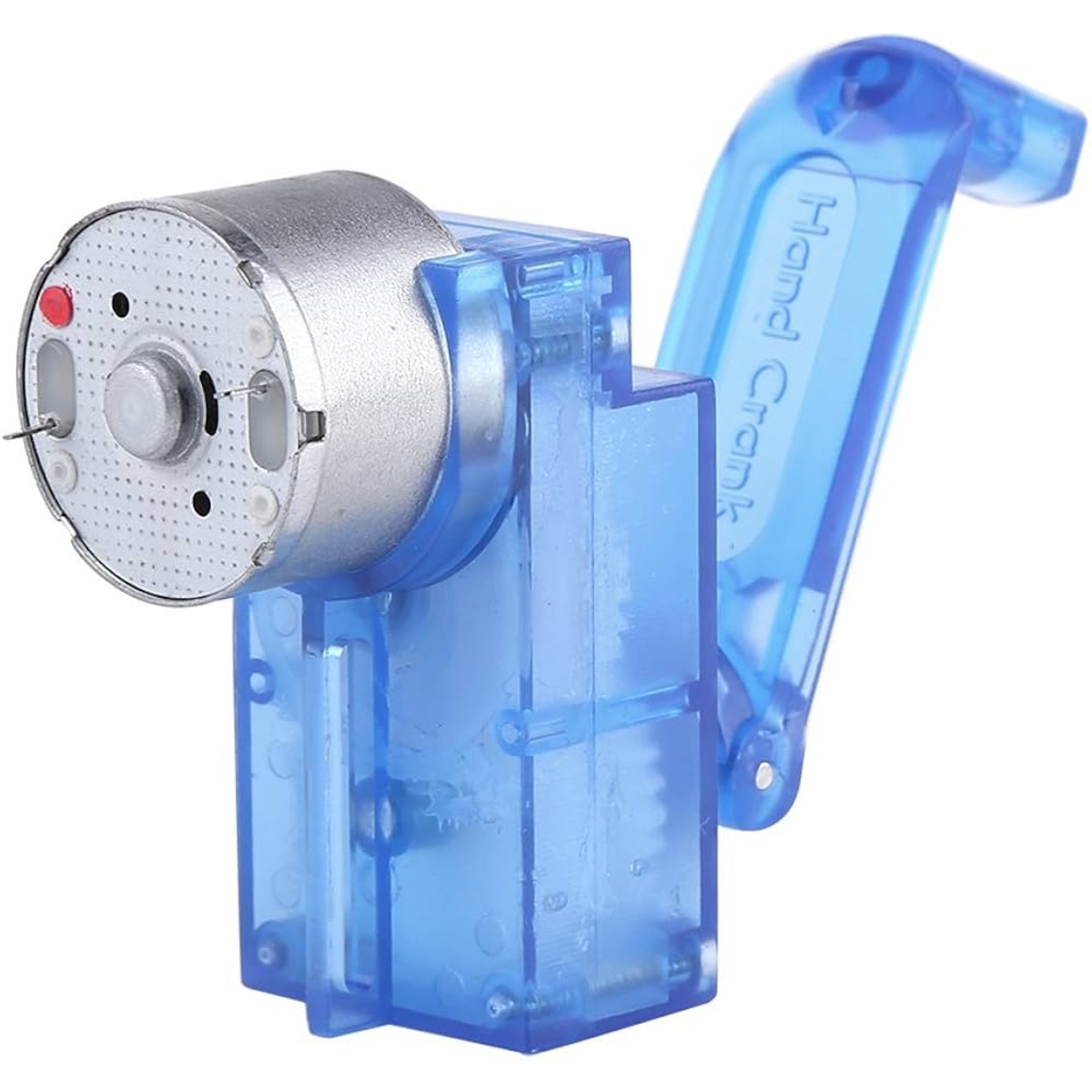 Portable Mini Hand Crank GeneratorEGP 1951 shopchecked 17 days ago
 OSEPP LS-00025 R140 1.5-3V 10000 RPM Brushed DC MotorEGP 1851 shopchecked 14 days ago
 MKS OSC V1 Stepper Motor Pulse Generator Controller Module With Manual ControlEGP 1851 shopchecked 17 days ago